A Practical Guide for Beauty Brands Launching or Scaling in Saudi Arabia & the GCC (KSA, UAE, Kuwait, Qatar, Bahrain, Oman)
If you are creating a new beauty brand in Saudi Arabia or other GCC countries, you will continually find the terms “White Label“, “Private Label“, “OEM” and “ODM” when looking for cosmetic manufacturers or contract manufacturing partners. These terms relate, however, they are not interchangeable. The decision of which model to use determines speed to market, degree of product uniqueness, cost, minimum order quantities, and ultimately your ability to defend your brand over time.
This article is designed to break down each term in easy-to-understand language, connect those terms to actual GCC go-to-market behaviors—and specifically, the most common question I receive from Gulf buyers:
“Can you create a product like this best-selling/trending product?” Based on my experiences working with GCC clients for more than a decade while living in South Korea, and as a result of having direct access to Korean factories, I have found that a single request from a client, asking for a product “similar” to a best-selling/trending product, can either be OEM or ODM-based, depending upon what the brand really brings to the table (i.e., the formula, reference, or brief).
1) White Label Cosmetics: fastest launch, least exclusivity
White label is generally defined as a product manufactured by one company, then resold by that company to many brands under various names.
In cosmetics, “white label” generally means:
- A formula is already developed and produced at scale
You add your brand name/logo to their product (typically with very little to no packaging options) - That same base product is likely to be sold to multiple brands (very little to no exclusivity)
Useful in the GCC: White label is useful when you need to quickly test demand (i.e., a basic body care product, or simple cleansing product), verify pricing, and begin distributing — especially when speed to market is more important than product differentiation.
Trade-off: Since white label is rarely exclusive, the long-term defense of your brand depends almost entirely on your branding, distribution, community engagement, and content, rather than product differentiation.
2) Private Label Cosmetics: branded for you, often with more differentiation
Private label refers to a third-party that manufactures the product for you, and you sell it under your brand — usually with some level of customization (the exact level of customization is dependent on the supplier and contract).
In cosmetics, private label typically includes:
- Selecting a current base formula and customizing it (i.e., texture, fragrance, actives, shades/finish)
- More flexibility in packaging and positioning
- Possible regional/exclusive channel (dependent on the supplier’s contract)
Strong option in Saudi Arabia & the GCC: Private label is good for brands that desire a product that has been customized for them — but do not require full from-scratch R&D — especially if you wish to customize for GCC consumers (i.e., heat-tolerant textures, sensory experience, fragrance intensity, and visible effects).
Trade-off: It is essential to understand what exactly is being provided as the “unique” feature:
• Is the uniqueness in the formula (to what extent?)?
• Or is it just the packaging and branding?
• Is exclusivity genuine (GCC-exclusive, KSA-exclusive, channel-exclusive), and for how long?
3) OEM Cosmetics Manufacturing: you define the product, the factory makes it
OEM (Original Equipment Manufacturer) means the brand provides the formulation/specifications, and the factory creates the product based on those specifications.
In cosmetics, OEM generally means:
- You provide the final formula/specification (or closely control it through your lab/chemist)
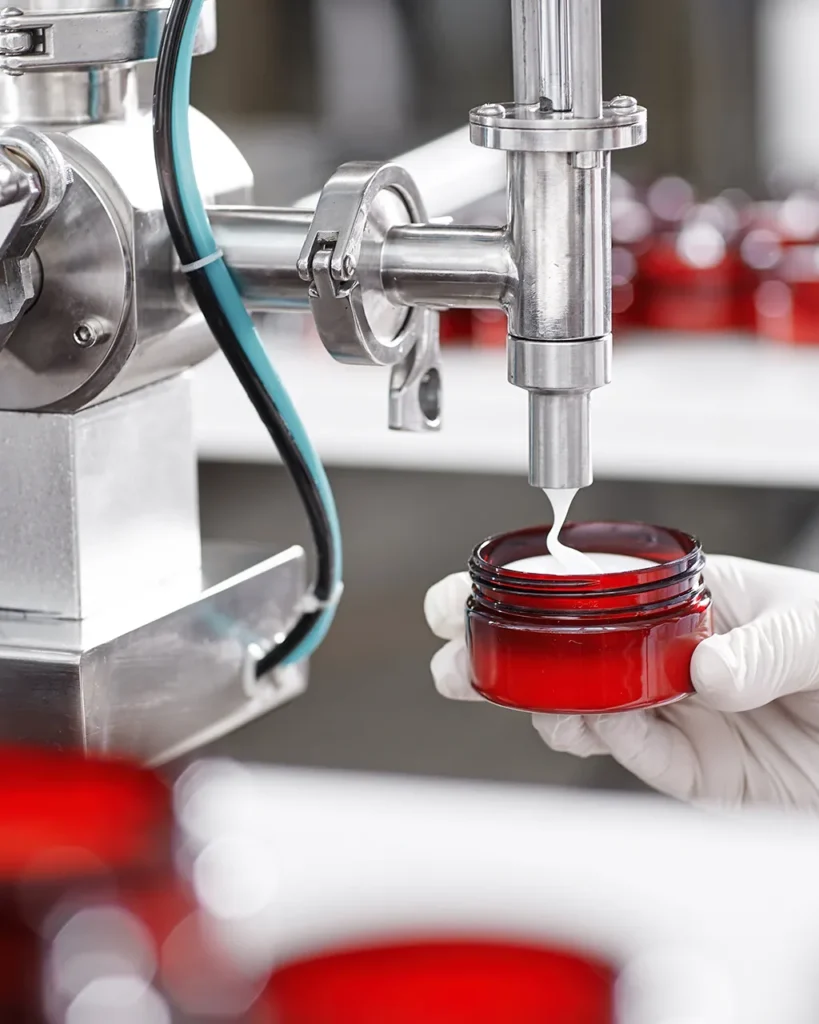
- The manufacturer focuses on execution: manufacture, fill, package, quality control
- You retain significant control over defining the product
Good for the GCC: OEM is a good choice if you already possess:
• A proven formula that you own, or
• A highly specified technical brief and you desire consistent scalability
Trade-off: OEM requires significantly more from you:
• Formula readiness and clearly documented specification
• Test plan and documentation preparation
• Compatibility responsibility for packaging (or co-responsibility)
4) ODM Cosmetics Manufacturing: the factory develops + manufactures (R&D-led)
ODM (Original Design Manufacturer) means that the manufacturer assists with design/development, in addition to producing the product.
In cosmetics, ODM typically means:
- The manufacturer performs R&D to develop or adapt the formula
- Performs stability/compatibility testing and optimizations
- “Ready-to-Customize” Platforms (very common in beauty)
Middle Ground for the GCC: ODM is a common compromise for teams that desire to deliver differentiated performance (especially in sunscreen, high performance skincare, modern base makeup textures) without establishing a laboratory of their own.
Trade-off: As the factory’s R&D is actively engaged, you should address these issues at the outset:
• Ownership of the formula/IP terms
• Scope of exclusivity (KSA/GCC/channel)
• Responsibility for documentation and regulatory files
The “best seller copy” scenario (most common GCC request): If the brand provides only a competitor reference sample, and desired modifications, it is usually handled as ODM-led benchmarking: the factory seeks to match the competitor’s performance/texture profile utilizing their own platforms and compliant formulations — rather than literally copying the product.
A Simple Comparison (How Most GCC Brand Teams Decide)
Select White Label if you want:
• Fastest route to launch
• Least amount of development work
• Quick test of market demand
Select Private Label if you want:
• Faster development with more differentiation
• Flexibility to modify the formula and packaging
• Potential exclusivity (dependent on supplier agreements)
Select OEM if you want:
• Strong control over the formula/spec
• A production partner to consistently scale
• You already have a formula (or have a lab/chemist developing a formula for you)
Select ODM if you want:
• Factory-driven formulation development and manufacturing
• Faster route to a "custom-like" performance
• Benchmarking a reference product (Commonly requested in the GCC)
In the GCC, the “correct” manufacturing model will depend on the focus of your brand:
- White label cosmetics = fastest entry, least exclusivity
- Private label cosmetics = faster, but with the possibility of more differentiation
- OEM cosmetics manufacturing = strong control over the product when you define the formula/spec
- ODM cosmetics manufacturing = R&D-driven development and manufacturing (often utilized when all you have is a reference product)